
2026: If Everybody Designs, What Makes a Designer?
Rethinking The Role of Design in Higher Professional Education
Call for Contributions 2026
Design is getting more and more attention in higher professional education. Professionals not only need research skills to understand issues, but also need design skills to develop plans what to do. As Herbert Simon observed “everyone designs who devises courses of action aimed at changing existing situations into preferred ones”. It implies that not only students who aim to become professional designers need to be trained in design, but also professionals who design. Whereas for professional designers, such as architects, product-, fashion- and multimedia designers their core identity and expertise is design, for professionals who design it is a merely tool or methodology to achieve a goal, often naming it ‘design thinking’. Consider communication specialists, doctors, policymakers or entrepreneurs. In Dutch, this would be about the difference between the ‘professionele ontwerper’ versus the ‘ontwerpende professional’.
In a wide range of study programmes — from engineering and healthcare to leisure, business and public administration — students work with design processes, prototyping, and challenge-based projects. Some universities of applied sciences even position Design-Based Education (DBE) as the leading didactic concept for all their study programmes. These developments raise relevant questions for education: what design skills do professionals who design need and are these fundamentally different from the skills of professional designers? What do students learn through designing — and for whom is that valuable? What does it mean when designing becomes a fundamental part of professional vocational training? And how do we see design in education: is it primarily a didactic process, a way to conduct research, or a tool to incite innovation?
As institutes of higher professional education are both training professionals that design and professional designers it becomes all the more relevant to consider the role, significance and implications of design in education. With this knowledge cycle, NADR aims to map out the diversity of views, practices and tensions surrounding aforementioned questions. This cycle includes four lenses or analytical perspectives:
Perspective 1. Blurred lines: design as professional identity?
What are the differences in design methods, tools and practices between professional designers and professionals who design? For instance, how can we describe the difference between a food-designer and a professional cook, or between a social designer and a creative social worker? Which design competencies are especially relevant for the professional that designs? Which competencies are - and will remain - characteristic of the professional designer, shaping their professional identity? And how do these identities and approaches relate to each other in education? NADR invites contributions that reflect on the positioning of design within specific study programmes or domains, and on the implications this has for professional identity and curriculum development.
Perspective 2 Applied Design Research: win-win for students and researchers?
(Future) designers need knowledge to design, and they can gain knowledge through design. Applied design research may contribute to both. But how does this work? How do applied design research projects contribute to student knowledge and vice versa? What is the benefit of the knowledge generated in applied design research projects for students in and outside of the projects? What knowledge is generated in student design projects? And how do we value these contributions as part of knowledge building? If students and staff work together, what are the unique learning gains of those constellations, and who learns what? And how do design quality, research quality and the learning process relate to each other? NADR invites contributions that address the knowledge base of design in education, and the relationship between making, researching and learning.
Perspective 3. Design-Based Education: design as an educational process?
Many schools, in- and outside of the traditional design disciplines, employ design projects as a central educational vehicle. What are the unique aspects of learning trough design projects, for instance applied in Design-Based Education (DBE)? How does it differ from similar educational concepts such as Problem-Based Learning (PBL) and Challenge-Based Learning (CBL), and what other educational means are necessary to properly nurture design skills? What makes design truly unique as an educational approach? Is it problem framing, problem solving, its iterative nature, working with prototypes, dealing with uncertainty, imagining the future? NADR invites contributions that compare and analyse which learning mechanisms are associated with design, reflecting on what design does or doesn’t contribute to the learning process.
Perspective 4. Design with impact: what can student achieve?
Students from all kinds of study programmes nowadays develop prototypes, interventions, concepts and future scenarios. But what is the actual value of these designs, and what do these student creations actually contribute? Is the primary impact didactic (student learning)? Epistemic (development of knowledge)? Or pragmatic (change in practical context)? How realistic is the implementation of new designs within the time frame of a semester? And how is the impact of new designs assessed or justified? NADR invites contributions that reflect on the value and legitimacy of student designs, both within and outside the educational context. Who gains what from student designs?
Submit your contribution HERE.

Process and timeline
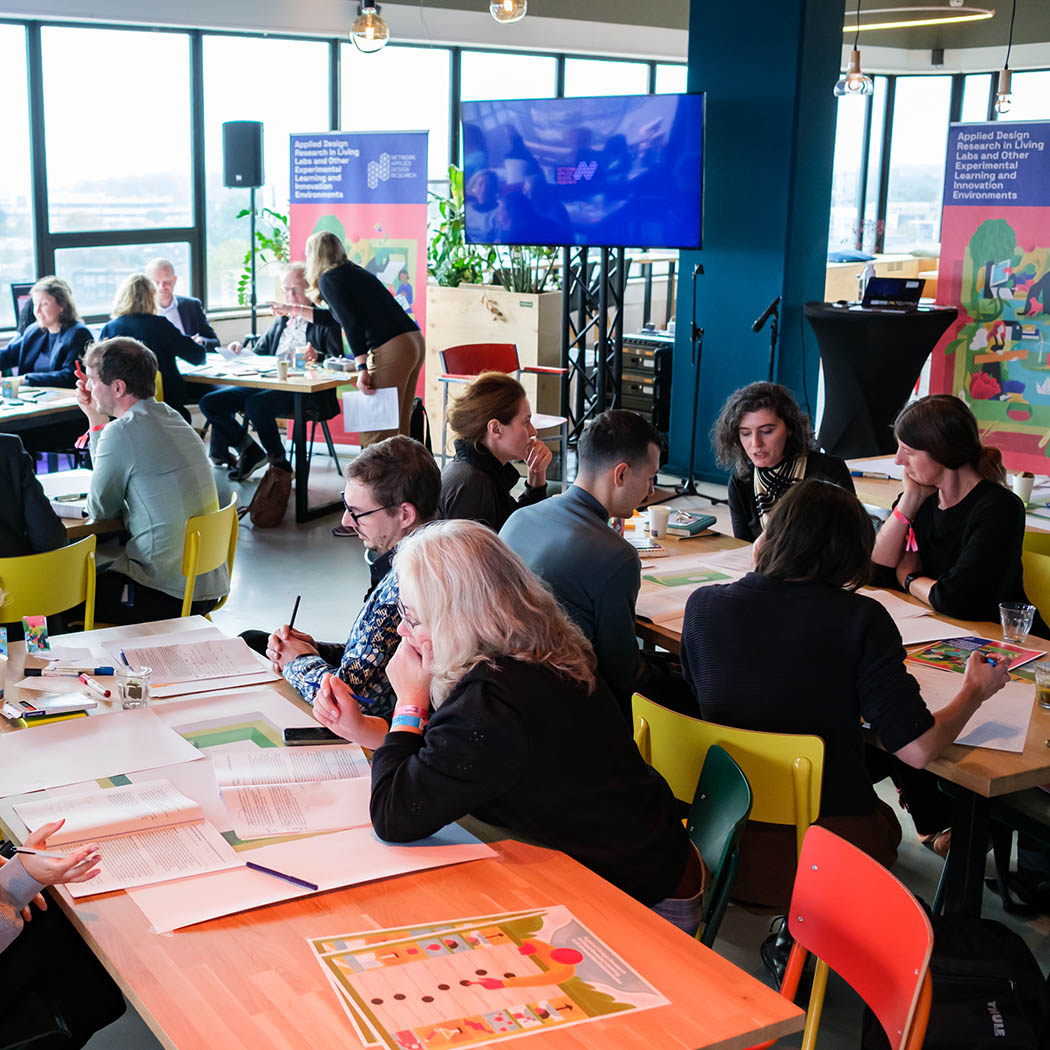
NADR invites professors and researchers to submit reflections contributing to one or more of these four perspectives. These are not problems or contradictions that need to be resolved, but rather they are lenses through which to reveal the variety of points of view. We invite contributions that describe a specific educational practice or case study, address one or more of the tensions we identified, analyse underlying assumptions and dilemmas, and reflect on the implications of these for applied design research in higher education. Based on the submitted contributions, all authors will collectively reflect on patterns, tensions and positioning of Applied Design Research in relation to education. By first mapping out the variety of the different perspectives, we aim to create a common basis for further development of ideas and possibly a shared positioning.
- Submission of short reflection / declaration of interest (max. 300 words): 6 May 2026
- Workshop to discuss and combine short reflections: Thursday 21 May 2026(13.00-17.00, live on location in Utrecht).
- Submission of intermediate contributions (max. 1000-1500 words): Friday 26 June 2026
- Feedback on intermediate contributions: July 2026
- Full contribution (for DDW): 1 October 2026
- Workshop & presentation at Dutch Design Week 2026: 19-23 October 2026 (exact date to be determined)
- Finalisation of full contributions based on feedback at DDW2026: November-December 2026
- Incorporation into collective publication: January-May 2027
Submit your contribution HERE.